Honor LightningvsPoppy Project Poppy Humanoid
For university robotics labs studying bipedal walking, spring-based joint mechanics, and design variations through 3d-printed body swaps, Poppy Humanoid is easier to deploy today — Lightning is the longer bet on capability.

Lightning
2 wins
Poppy Humanoid
2 wins
Category breakdown
Deploy & operate
Readiness, uptime, navigation & connectivity
- 15Deployment readiness35
- 60Maintenance confidence60
- Vision-led navigation (estimated)NavigationVision-led navigation (estimated)
- Wi-Fi / cloud fleet management (estimated)ConnectivityWi-Fi / cloud fleet management (estimated)
Cost & ROI
Price accessibility and ROI clarity
- 77Price accessibility92
- 5ROI clarity25
Capability
Payload, speed, runtime & labor replacement
- 20Labor replacement15
- unknownPayload25 degrees of freedom, multi-articulated trunk with 5 degrees of freedom
- 50:26 for 21 km half-marathon (autonomous)Speed—
- can maintain high power output for nearly an hourBattery—
Fit & future
Environment fit, footprint & long-term upside
- 65Environment fit45
- 80Future potential70
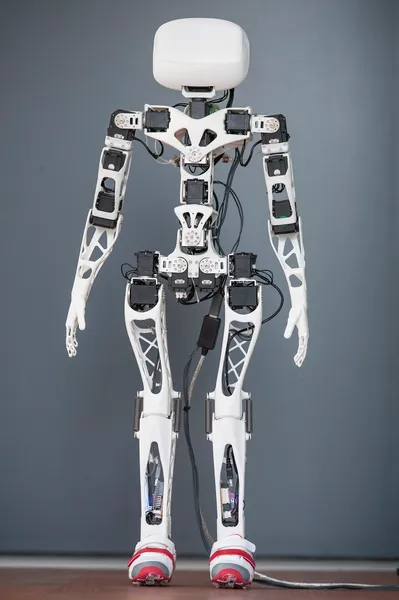
- 169 cm height, 95 cm effective leg lengthFootprint850 mm height
Lightning · Best for
Endurance benchmarking for bipedal locomotion research
Poppy Humanoid · Best for
University robotics labs studying bipedal walking, spring-based joint mechanics, and design variations through 3D-printed body swaps
Final judgment
If immediate deployment is the priority, choose Poppy Humanoid. If the goal is to be ready when Lightning's capabilities mature, track it.